
Friends, don't take my word for it - click around yourselves.Interactive: https://longread-virid.vercel.app/coefficient/The calculator will work out your city, you'll see the Fan ID effect, look at photos of the stadiums and what a minute inside one costs, and a slider will take you back to 2018. When you've had enough playing, come down to the text.
The classic RPL attendance table answers only one question: who gets more people into the stadium in absolute numbers. That's useful for the league and for television, but it says almost nothing about how deeply football is woven into the life of a particular city. In 2025/26 this is especially visible: Krasnodar is breaking records again, Zenit traditionally packs in close to forty thousand, and Kaliningrad, for the first time in many years, gets into the big picture at all.
If you change the lens and ask "what share of the city, on average, comes to the stadium on matchday", the RPL picture is redrawn. All you need is three numbers: the club's average home attendance, the city's population, and a simple formula - attendance divided by population, times a hundred. The result is a metric I calculated for Kaliningrad: in last season's First League Baltika pushed the share of the city in the stadium to 2.8% and, by this metric, overtook everyone, including the Moscow clubs and Krasnodar.
RPL 2025/26: Kaliningrad is the country's number one football city
In the Premier League the logic stayed the same, but the scale grew. By the end of 2025/26 the league had set new records: total attendance came to 3,270,691 spectators (a 12.57% rise in average attendance, the best figure in six and a half years), and the best-attended round was the 30th (160,781 spectators, an average of 20,098 per match). The engine of the growth is obvious: champions Krasnodar, Zenit and a wave of regional bowl stadiums.
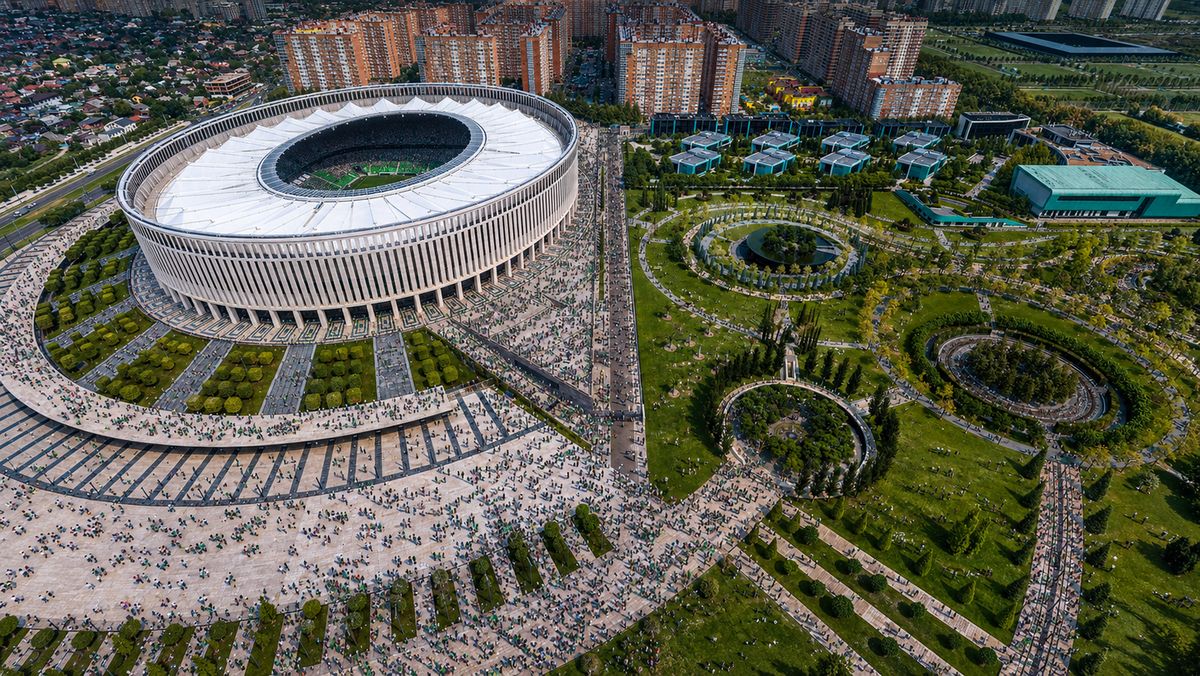
Overlay this on demographics and it turns out the country's main "football city" is not Moscow and not even Krasnodar, butKaliningrad. According to Rosstat, about 488,700 people lived in the regional capital at the start of 2025. Baltika's home matches in 2025/26 drew an average of 17,139 spectators, which puts the Rostec Arena at roughly 49% capacity. Converted into a share of the city, that's already about 3.5% - the highest figure in the RPL in 2025/26 and a number that even the top clubs from cities of a million-plus are nowhere near.
Krasnodar is second by this metric: with a city population of around 1.21 million and an average home attendance of almost 29,400 in 2025/26, its share is roughly 2.4%. Akhmat's figure is more modest in absolute terms but noticeable relative to the city: with Grozny's population at around 399 thousand, a match draws about 4,400 fans on average - roughly 1.1% of the population. Behind them comeRostov, Kazan, Samara - cities where the stadium clearly feels like the "town square" of the weekend.
Moscow and St Petersburg look completely different against this backdrop. With 13.27 million residents in Moscow, even 23-24 thousand at the Lukoil Arena amounts to only about 0.18% of the city, and 15 thousand at CSKA or Dynamo is even less, around a tenth of a percent. St Petersburg, with a population of around 5.65 million and an average 37-38 thousand at the Gazprom Arena, also ends up at the bottom of the "share of the city" table (around 0.67%), even though by absolute attendance Zenit remains the league's biggest magnet.

Why share of the city matters more than raw attendance
A simple share-of-city figure solves several problems of classic statistics at once.
First, it removes the distortion between million-plus cities and mid-sized ones. On a "population vs attendance" chart, clubs from big agglomerations always look weightier: even in a bad season Spartak will still draw more people than any provincial club. But divide attendance by the city's population and it turns out that for the average Samara resident a trip to Krylia Sovetov is a far more mass practice than a CSKA match is for a Muscovite.
Second, this metric better describes the "football saturation" of a place. Kaliningrad, at 3.5%, literally lives around one club: on matchday every 28th resident of the city is in the stadium. By comparison, for a Moscow club to reach the same share it would have to draw 450-500 thousand spectators to every home match - obviously beyond the physical capacity of any stadium.
Third, share of the city lets you compare success stories in the First League and the RPL honestly. Kaliningrad had already learnt to live at 2.8% in the 2024/25 FNL, when Baltika's average attendance was 14,200, and it has essentially carried the same model of support into the Premier League, just on a bigger stage. Krasnodar, by the local authorities' own estimate, has de facto long outgrown the official city statistics and in reality amounts to an agglomeration of close to 2.3 million - against which even its impressive attendance figures look a little more modest as a share of the city.

The RPL as a demographic atlas
Line up the RPL 2025/26 clubs in a table with three columns - city population, average home attendance and share of the city in the stadium - and the familiar hierarchy changes. At the top are not the richest clubs or the ones with the biggest stadiums, but those who genuinely turn a match into a city-wide event: Kaliningrad, Krasnodar, Grozny, Rostov. Somewhere nearby but a little lower are Samara, Kazan, Nizhny Novgorod - big regional centres where football still competes with other ways of spending leisure time.
For the league this is an important signal. You can argue endlessly about foreigner limits and the tournament format, but if you look through the eyes of a city, the main difference between the RPL and any other Russian league is how tightly it sits on the local agenda. When every Baltika home Sunday gathers more than three percent of the city, a football match stops being mere entertainment - it becomes a new form of town meeting.
That's exactly why next season one more line should be added to the attendance figures in the official reports: share of the city in the stadium. It would make it easier for the league to explain its growth, for clubs to talk to the authorities and to fans in the language of "this is the share of the city we bring to the stadium", and for journalists to go beyond the banal "the team broke its attendance record" without any context for what stands behind the numbers.
Don't forget to subscribe to the Telegram, that's where the announcements are and the things that don't make it in here https://t.me/BalticaB


