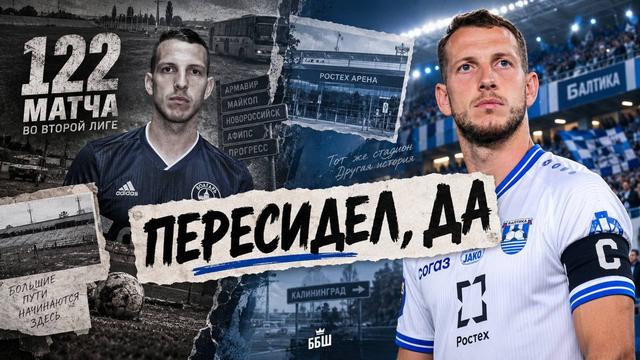
On 11 April 2026 Eldar Civic came on after the break. In the 48th minute he stood over the ball at the right edge of the box — a free kick won by Lacerda, the winter signing who'd come on for the injured Brayan Gil. Civic drove it low past the wall towards the near post; Medvedev got a hand to it, but the ball flew in off his gloves.
In the 57th minute he picked up an injury. In the 58th he was replaced by Mikhail Ryadno.
On in the 46th, scored in the 48th, off in the 58th. Twelve minutes — and everything Civic does in Kaliningrad fitted into them.

Two brothers from Tuzla, one position, different orbits
Tuzla is an industrial town built on salt mines, two hours from Sarajevo. There are two footballers in the Civic family, and both are left-backs with a working left foot.
In 2012 both left Sloboda for the Czech Republic. Eldar, sixteen, went into the Slovácko system. Muharem, three years older, ended up at Táborsko, where he spent two seasons in the youth team.
Then the orbits diverged. Muharem returned to the Balkans and played at home from then on: Sloboda, Velež, Krupa, Tuzla City, and now Sloga from Tojšići. In 2023/24 he made nine assists for Sloboda, the best tally in the team, and the club won the First League of the Federation of Bosnia.
Eldar stayed in Central Europe. Eight years after leaving Tuzla he walked out at Camp Nou.
He scored his first professional goal on 2 April 2016, against Sparta Prague. A little over a year later Sparta bought him. Back then, when the Czech press was calling him the discovery of the season, nineteen-year-old Civic told Balkan outlets:
"I have a contract with Slovácko, and my future is in the club's hands. I won't rush a change of scenery."
No agent's hints, no "I'm ready for a big club". Just as calmly he'd go on loan to Trnava in Slovakia — and win his first league title there.
An empty Camp Nou and Messi, broken down defender-style
On 20 October 2020 he walked out at Camp Nou against the club he'd supported since childhood. Champions League debut, aged twenty-four. And not a single spectator: Covid protocol, official attendance — zero.
"When you play against them, you just can't believe you're standing next to them. At the time Barcelona, I think, weren't in their best form, but when they get the ball — it's definitely another level."
That evening Messi converted a penalty and became the first player to score in 16 consecutive Champions League seasons. Barça won 5:1. It's telling how Civic describes the opponent — not as a fan, but as a defender who had to mark him:
"When Messi gets the ball, you never know where he'll go, which way and how, because his skill and agility are just incredible."

Six league titles that Baltika got for free
He spent July 2019 to June 2025 at Ferencváros: 191 matches, six Hungarian titles in a row, a Cup, 53 European games. He didn't sit out his contract on the bench — in his final season he was second in the team for chances created.
Baltika got a player like that for nothing: the contract had expired, and in the Hungarians' "transfer fee" column there's a dash. According to insiders the salary came to about €500,000 a year — officially the club didn't disclose the terms. It still took six months of persuasion: talks went on from December, and the decisive factor was the phone calls of Stanislav Cherchesov, with whom Civic had won a league-and-cup double in Budapest.
"He called me and told me all the best things about the club and the city. He said Kaliningrad is a very good city and Baltika is a stable team."
Telling, too, is who didn't call. When Dejan Stanković left Ferencváros for Spartak, he took Abena and Marquinhos with him. Civic jokes without resentment: "Maybe he doesn't need a left-back."

Matchday nine, second place: "Anything is possible, because it's football"
He voiced his faith in this Baltika before it became a sensation. By matchday nine the team was second, and he said out loud what nobody at the club would say out loud: "Fighting for the title? Anything is possible, because it's football."
And in October, with 24 points after 13 rounds, he delivered a formula that went straight into the headlines:
"If Leicester won the Premier League, why can't Baltika win the Russian championship?"
How he breaks down the defeat to Zenit
Especially revealing is how he analyses the match in St Petersburg, lost 0:1:
"We could have beaten Zenit. The game was in St Petersburg, but we had our chances. One mistake — and they punished us straight away. But that game against Zenit, I think, came easier to us. We conceded just an unlucky goal, and we neutralised their chances. If our goal had stood, I think we'd have won."
He separates a fluke goal conceded from a structural error. He remembers the disallowed goal — and doesn't steer the conversation onto the referee. And he admits the champions were an easier opponent than Krasnodar, though it would have been more convenient to say the opposite.
When after 25 rounds Baltika had conceded just 15, he brushed aside the secret of the league's best defence with one word:
"It's not a secret, it's all work. Good work. I see that in every training session the lads give their maximum. In football you're always repaid in the game for what you do in training."
In a whole season of his quotes you won't find complaints about the schedule, the flights from the exclave or the refereeing. There were plenty of reasons to — no question.
"There are no irreplaceable players there"
Back to 11 April. The free-kick goal, the injury, Baltika lets a win slip — 2:2, Sven Karič scores from a free kick in stoppage time.
Eight days later Civic misses the Krasnodar match, and Murad Musaev answers a question about the Kaliningraders' absentees:
"Baltika is a structured team, and there are no irreplaceable players there."

The coach of one of the league's leading teams is effectively saying: we're not afraid of your absence. The match ended 2:2.
Civic says roughly the same about himself — just with a different intonation. The man has 53 European matches and seven league titles, and for international experience few in this Baltika can compare with him:
"I have a lot of European matches, but I don't look at it as if I'm the most experienced one here. When I see I can help someone, I help. I don't want the lads to think I put myself above them."
Duolingo and swearing from teammates
A thirty-year-old footballer moved to a region wedged between Poland and Lithuania and decided to learn the language. No teacher, just an app.
"I try every day, I'm learning Russian because I need it — a lot of people here don't speak English. Let's say I've learned more than 50% already."
The vocabulary honestly reflects daily life: "hello", "how are you", "good", "first", "second" — "everything to do with training". Plus what he was taught in the dressing room: "I think I know a lot of bad words, but I'd better not say them."
And then an observation not every foreign player reaches even after five years:
"Czechs, I think, are more like Germans, and Hungarians are friendlier. Here in Russia I like that the mentality is almost like in the Balkans."

The World Cup he didn't go to
Bosnia qualified for the 2026 World Cup. Civic isn't in the squad, and the last time he played for the national team was 21 March 2024 — in the Euro 2024 play-off semi-final against Ukraine in Zenica. He came on in the 67th minute, Bosnia lost 1:2 and didn't go to the tournament. He has 28 caps in total.
He could have talked about injustice, about nobody watching him in the RPL. What he said was:
"I think every player wants to play at the upcoming World Cup, but I know I haven't earned the right to go there with the Bosnia team. I wish the players who were in the squad to make it to the World Cup."
"I know I haven't earned it" — a phrase you hear from a professional footballer approximately never.
The third minute in Samara and the armband in Makhachkala
He started 2026/27 the way defenders usually don't. Matchday three, Samara, third minute: a delivery from Ayman Murid, a first-time finish, 1:0, final score 2:0.
Shalimov described that goal in more detail than Civic himself:
"Civic side-footed it with technique, neatly into the corner past the keeper — like potting a ball. That's the craft and quality I really like."
Krylia coach Sergei Bulatov admitted after the match that they'd prepared for the Kaliningraders' set pieces — and still couldn't cope.
On matchday four against Spartak, Civic struck the post from the edge of the box at 1:2 — Baltika's closest moment to a rescue. And on 20 August in the Russian Cup against Dynamo Makhachkala he came on at half-time for Mingiyan Beveev — and came on as captain, taking the armband from a teammate who had been booked in the first half. The match finished 1:1, Baltika won the shoot-out 5:4.
The armband is familiar to him: in Bosnia's under-21s Civic was captain.

"When I wear it, I always try to push the team forward. I respect this club, these people, my teammates. Not only when I put on the armband, but without it too, I want to lead the team forward."
He took the last penalty. And explained it in a way that best shows why a team needs a player like this:
"I let the lads choose who takes which one. It doesn't matter to me whether I go first or last. A penalty is a penalty, there's always a bit of pressure, especially when you're last, but that's normal, I need to take responsibility on myself."
A dream said out loud
His personal football dream is to win the RPL with Baltika. Not "fight for Europe", not "establish ourselves in the league". The global one is the Champions League, because "when you hear that anthem... it's just madness".
He has heard the anthem. At Camp Nou, in the emptiness, against Messi — and lost 1:5.
He talks about the dream without pathos, in the same even voice he uses to explain that he doesn't stand out among his teammates. A man who at thirty learns Russian on his phone and apologises for his mistakes is, somehow, easy to believe.

That's Eldar Civic for you! Calm, cheerful, level-headed, with a stunning left foot)
We discuss Baltika's prospects in the league here — https://t.me/BalticaB