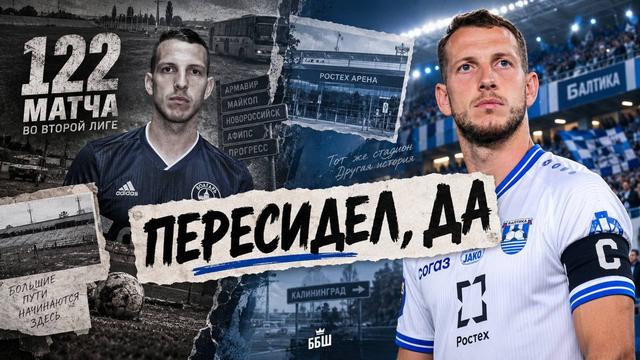
Two facts, with ten years between them.
In January 2016 Ilya Petrov plays for Russia's youth team alongside Zobnin, Barinov and the Miranchuk brothers and wins the Commonwealth Cup. In the summer Dynamo Moscow sign him. He is 20, and by every law of the genre the Premier League should come next.
He played his first RPL match on 18 July 2025. He was 30 years and three weeks old.
This is not a story about "never give up". It is about a different question: what do you do when your level is above the league you play in, and for ten straight years football simply doesn't give you the chance to prove it?
The boy whose father didn't take him home
At thirteen Petrov left Nizhny Novgorod for the Master-Saturn academy in Yegoryevsk; his home city had no school of RPL standard at the time. And straight away comes the scene that explains the whole biography. "As soon as my father drove off, I called him an hour later and said, 'Come and get me out of here.' My father said, 'No, you're staying,'" Petrov told Championat.
His first wage was 4,600 roubles a month. Two years later the senior Saturn went bankrupt with debts of more than 800 million, and staying at the academy became pointless. A thirteen-year-old was handed the storyline of his entire career: clubs in Russia close down, and you are left standing.
Krasnodar, before there was even a training base

After Saturn's bankruptcy there were options in Moscow, but none of them offered boarding. So in 2011 Petrov ended up at the Krasnodar academy, at a time when the academy, in effect, didn't yet exist. "The academy didn't even have a base; we lived in cottages. Two cottages for one age group, and the nannies and house-parents lived with us." The base opened a year later. And then a piece of honesty you rarely get from people whose status as a graduate of the Russian champions now appears in every news item: "I think at that time the Saturn team was actually stronger."
He never got past the reserves: under Aleksandar Marjanović's Serbian staff, academy graduates weren't let near the first team, while the purchased players were sent down to the second string. One verifiable detail hits harder than any grievance: of Petrov's graduating year, exactly one player, Nikolai Komlichenko, is in the RPL today.
There is no grievance, though: "Galitsky genuinely deserves a monument in Krasnodar." Said by a man who never made it up through that system himself.
The only 1995 in the FNL
In 2013 he deliberately went home, to the reserves of Volga Nizhny Novgorod: the reserves were fifth, the first team was in the RPL, adult football was within touching distance. The first team did happen. Only by then Volga had been relegated. On 19 July 2014 Petrov made his First League debut against Anzhi, a team relegated alongside them. "All my friends and my parents came to the game. Unfortunately, we lost."
The key number of this chapter: he was the only player born in 1995 in the entire FNL. Not one of a few. The only one. At 18 or 19 he was playing where thirty-year-olds play.
2016: the year he had already arrived
On 17 January 2016 Petrov made his debut for the youth team. Not a token one: four matches at the Commonwealth Cup, a tournament win, then the U21 Euro qualifiers; the RFU records five official youth caps.

He was the only First League player in that squad. Around him were Zobnin, Barinov, the Miranchuks, Khaikin, Zinkovsky. Half of that list was playing for the senior national team within a couple of years.
That winter Zenit-2 and Rubin were interested. Volga wouldn't let him go: they said the team needed him. Six months later Volga ceased to exist.
Remember this paragraph: it will be repeated three more times in different scenery. A player isn't released because the club can't do without him, and then the club simply isn't there.
The central question of this piece is posed by Petrov himself, and better than any journalist could: "Why did your progress stall, unlike Barinov, Zobnin, the Miranchuks?" "I don't know myself. I still have no answer to that riddle."
"You could say I was never really at Dynamo"
In the summer of 2016 Dynamo were relegated from the RPL and called Petrov. At the same time the phone rang with Dmitri Cheryshev, freshly back from Spain to take charge of Mordovia.
They devised a scheme: a contract with Dynamo plus an immediate loan to Saransk. What follows is the most absurd fragment of the biography, word for word: "I never even spoke to the coach or set foot at the training base, so there's no gold medal for winning the First League either. I just signed the contract in the office and left. The next time I went there was to terminate the contract. You could say I was never really at Dynamo."
The reference books say: 2016-2018, Dynamo Moscow. In reality: zero matches, zero training sessions, zero conversations with the coach, zero medals for the FNL title season.
At Mordovia he played 24 matches and, by his own count, had nine goal contributions at 21. The team was relegated to the Second League. Next came a loan to Avangard Kursk: 11 matches, one goal, and on 30 January 2018 the agreement was terminated. The rights still belonged to Dynamo, something Sport-Express stressed separately when reporting his next move.

From Dynamo Moscow to sleeping in a coat in Portugal
On 31 January 2018 the 22-year-old Petrov became a player of União de Leiria.
Not Benfica. Not Sporting. Not even the top division: Wikipedia places his debut on 3 March against Fornos de Algodres in the Campeonato de Portugal, that is, the third tier. Petrov himself always says "Second League" and remembers a match against Benfica B. We note the discrepancy and don't edit the hero's quotes.
The club then employed the Russian executive Aleksandr Tolstikov, there were four Russians in the first team, and in the youth side were Yegor Golenkov (we're expecting him at Baltika) and Bogdan Ovsyannikov. Petrov explains the motive without pathos: he wanted to see Europe.
The outcome on the pitch: two matches. The reason was a foreign-player limit that only fell away in the top flight, and Leiria didn't get there.
The outcome off the pitch is the best material in this text. A wage of 1,000-1,200 euros a month, "fairly small" after Saransk. The club rented the flat, but utilities ate up 200-300 euros: "For me that was a significant sum." The rest he would tell Match TV once he was already a Baltika player:
"Second League, no heating in the houses. We slept in coats. Football-wise, I enjoyed it. Everything was done with the ball. Long training sessions, they often ran over. Players could get distracted by a plane flying overhead."
That is the portrait of the player in a single paragraph. A man who pays a quarter of his wage on utilities and sleeps in a coat, and in the same answer manages to say he enjoyed it.
The professional takeaway from there matters more than the domestic details: "At Leiria every session was with the ball. It felt like I came back to Russia more technical."
He didn't leave because of the cold: the point of staying had expired. Leiria hadn't gone up to the top flight, the limit hadn't gone anywhere. Petrov wrote to a coach he knew at Mordovia: "Let me come back." The coach agreed.
The wandering years
A route that begs to be drawn on a map: Nizhny Novgorod - Yegoryevsk - Krasnodar - Nizhny Novgorod - Saransk - Kursk - Leiria - Saransk - Nizhnekamsk (in practice Kazan) - Krasnodar - Khabarovsk (in practice St Petersburg) - Kaliningrad.
And it turns out Petrov has a unique collection of clubs that couldn't play at home.
Mordovia, 2018/19. A stadium and pitches left over from the 2018 World Cup, 36 matches, 4 goals. A year after he left, the club was relegated and shut down: the third club to vanish during his career.
Neftekhimik, 2019-2021. His best individual spell: 6 goals in the first season, 10 in the second. And at the same time pure footballing surrealism: the team played its home matches first in Kazan at Rubin's base, then at the Mordovia Arena of all places. Petrov summed up his feelings for Sportbox exhaustively: "It'll be more comfortable when the stadium in Nizhnekamsk is built and we really play at home, instead of away like the whole of this season."

Kuban, 2021/22. 29 matches, 2 goals and an almost literary detail: as a teenager he'd watched the Kuban vs Krasnodar derby from a stand where flares were thrown at the kids' buses. Now he was playing in that derby, and won it 3:0 in the Russian Cup.
SKA-Khabarovsk, 2022-2024. 64 matches, 11 goals, a project with promotion to the RPL as its goal. For the first few months home matches were played in Kazan. Then they were due to return to Khabarovsk, and a couple of weeks before the spring half the undersoil heating at the local stadium packed up. The team decamped to St Petersburg, and players who had already rented flats in Khabarovsk were cancelling their leases. "It was a blow for everyone." In the autumn SKA were fifth and a point short of the play-off places; in the spring they collapsed. Petrov names the reason bluntly: they played without their own city and their own fans.
Notice the pattern that romantic pieces tend to miss: almost none of his setbacks were about football. Saturn's bankruptcy, Volga's liquidation, Mordovia's death, the neutral grounds of Neftekhimik and SKA, the broken heating in Khabarovsk, the foreign-player limit in Portugal's third tier. The player did his job. It was the infrastructure that kept breaking his career.

278 matches and a call from Kaliningrad
The key point: by 2024 he was not a spent force. His last season in Khabarovsk: 36 matches, 4 goals, 8 assists, while everything at the club was changing around him.
At the time of his move to Baltika, Legalbet put his First League record at 278 matches, 40 goals and 33 assists. The terms were anything but starry: a free agent, a contract to 31 May 2025 with a one-season option. "When Baltika called, two days later I flew to Kaliningrad."
The start of the season under Grishchenko didn't work: the team had plenty of the ball and scored little. "Grishchenko's football was better suited to the RPL. In the First League it didn't work." With Andrei Talalaev, the coach under whom Petrov had once taken his first steps in adult football, something different began: "We put on shin pads. Every session in them, in tackles and duels. Nobody spared anybody."
On 1 February 2025, before promotion to the RPL, the club extended his contract to 2027. For a player turning 30 in June, that was not a courtesy but a statement that the club believed in him.

A birthday present
On 27 June 2025 Petrov turned 30: more than 300 First League matches and not a single minute in the Premier League. "All my friends laugh and say, 'Finally you'll get a present for your big birthday.'" He didn't go on holiday; he stayed in Kaliningrad to train, so as not to miss the debut.
18 July 2025, round one. Dynamo Moscow vs Baltika. Petrov starts and plays 67 minutes.
It's almost embarrassing to praise the scriptwriters here, the work is so crude: the club he signed for at 20 and never once trained with became the opponent in his first RPL match, exactly nine years and one month later.
And it didn't end as a one-night fairy tale
From here it could have turned sentimental: the veteran got there, played, roll the credits, thank you all. But in the 2025/26 RPL Petrov played 27 matches, 25 of them from the start, scored a goal and provided three assists. Minutes: 1,899 according to Championat and 1,919 according to Transfermarkt; the aggregators disagree on both minutes and assists. His first Premier League goal came on 24 August 2025 in Sochi.
Eight yellow cards and two matches missed through accumulation are part of the portrait too. He is no passenger: he covers the ground, carries the ball forward, goes into tackles where his frame isn't big enough for them.
Baltika finished sixth with 46 points, the best result in the club's history and the best adaptation by an RPL newcomer in 23 years.
He explains it himself without melodrama: "I came into the RPL at thirty, when I'd already gained experience and grown stronger mentally and in character. The RPL comes easily to me" (Euro-Football).
That is the resolution. Not "dreams come true", but "it turned out he could do it all along".
The circle closed twice
For now the ending is coming out a little crueller than one would like.
In the 2026/27 season Petrov has 79 minutes from the first six rounds: 45 in round one against CSKA, 34 against Rubin, and four matches as an unused substitute. After round one Talalaev said the team needed reinforcement in midfield (Championat). On 30 August in Khimki Baltika thrashed Rodina 3:0, without him in the starting line-up.
And one detail on its own: in round two, on 1 August 2026, Baltika beat Dynamo 2:1 at home. Petrov sat that match out on the bench. The same club, almost the same circle, only this time without him.
A couple of conclusions matter more than a moral.
First: this is not a story about a lack of talent. The only 1995 in the FNL at nineteen, the only First League player in the youth national team, 16 goals for Neftekhimik in two seasons. It's a story about how five times circumstances forced him to start almost from scratch
Second: thirty as the entry point to the RPL is not a sentence but an advantage. 25 starts for a league newcomer that finishes sixth is the result of a man who had already seen everything by the time he debuted.
Third: Yes, this season he isn't playing much, more often in the Russian Cup, but when did Ilya ever give up?
The boy who, an hour after his father left, begged to be taken home from boarding school became a footballer who slept in a coat in a Portuguese flat and still says he has no regrets. Nooo, lads like that don't usually vanish from the team quietly.

The end, and if you read all of it, well done 🙂