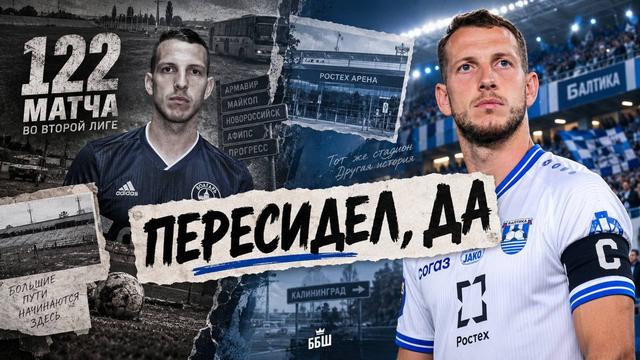
The big story of Aleksandr Filin - from a second-hand shop in Simferopol to Baltika's armband

Right now he is on crutches. He's recovering in Moscow after surgery on his cruciate ligaments, counting the days to November - the rough date when he'll be able to step onto a pitch again. Around him are his family, his children and, in his words, the best rehabilitation specialist there is. Psychologically, he admits, it's harder than he expected. But the voice is calm, as if he has already been through this too.
And here's the thing: if you scroll through every interview Filin has given in ten years of professional football, you simply won't find an easy road anywhere. He left Donetsk at the height of the political crisis. He refused to "bounce around on loan", even though that is the most obvious option for a footballer without a place in the team. He gambled his career on a year and a half in Belgium, where nobody saw him as a starter at all. He lived through the bankruptcy of Khimki - no money, no clarity, no guarantees. And he ended up captain of a team the whole country was comparing to Leicester.
The crutches are not the finale. They are the next chapter in the biography of a man who is better at starting over than anyone else in this team.

A cinder pitch and boots from a second-hand shop
Aleksandr Filin is Simferopol born and bred, and his path into football didn't begin with enrolment at a sports school but with tagging along to his older brother's training sessions. There was no intake for his age group, so he had to improvise: "They'd put a bench out for me and I'd bang the ball against it like a wall. Later a team formed," he recalled in an interview with the Khimki press office. The pitch was cinder - "like gravel, only black and dusty" - and after training he'd walk off it, in his own words, "like coming out of a mine".
His first boots weren't bought in a shop but in a Simferopol second-hand store: "I remember saving up 120 hryvnia and buying Adidas, like Beckham's, two sizes too big, and waiting for my foot to grow into them." At 16 he left Crimea for the academy of Shakhtar Donetsk and landed in a club system where the small details were controlled almost like in the army. Learning grown-up football from scratch, far from home - that's no longer childhood, that's a stress test.
Donetsk, 2014 and the break with Shakhtar
At Shakhtar Filin became friends with another academy graduate, Oleksandr Zinchenko. Together they made the youth team squad for the Champions League tournament, Manchester and London - although he never actually got to play.
When the protests began in Ukraine, Filin was in Donetsk. All the academy's age groups were moved to the base in Poltava because of the situation in the Donbas. "I remember one time I'm walking to collect my wages near the Verkhovna Rada building, I turn a corner - and there's the riot police, ready, locked and loaded. I just turned round and got out of there, and the chanting had already started…"
He never broke into Shakhtar's reserve side. He didn't want to bounce around on loan at the feeder clubs, Mariupol or Zorya: "It turned out I wasn't needed. I had no intention of going around on loan, so I tore up my contract with Shakhtar." He formalised his Russian football status in August 2015, through his grandfather: "My late grandfather, Boris Vasilyevich Filin, was born and lived in Russia, so I was entitled to Russian football citizenship." And he set out his ambitions straight away, with no excess caution: "I want to play for the Russian national team! And not just play, but help it win," said the 19-year-old Filin in 2016. About Zinchenko he was prophetic even then: "I'm sure he'll be a regular in the national team very soon."
From there their paths diverged as starkly as it gets. Zinchenko became a star - Manchester City, Arsenal, and in 2026 he ended up at Ajax. But he too finished the season with a knee injury and surgery. Filin's year ended in a similar way. Different careers, one strangely rhyming season.
Ufa: one game and a first iPhone
At Ufa Filin shared a flat with Zinchenko, and the difference in status was felt immediately: "His salary was a lot higher than mine, so he covered all the expenses - he wouldn't let me pay for food or the flat." Together with him and Andrei Lunev, now Dynamo's goalkeeper, they'd stay after training to hammer free kicks - the coach punished them for going AWOL, deciding that extra sessions hinted the workload wasn't enough.
In two seasons at Ufa Filin played just one match in the RPL. But what a match - against Zenit, against Witsel, Dzyuba and Shatov: "My knees were shaking. In the tunnel I genuinely didn't know where I was. I ran around until they took me off. Something like 60 or 70 minutes of running myself into the ground." The team won 1:0. That same day Filin bought the first iPhone of his life - before that he'd used Samsungs. One game, and straight into a new era, at least where the phone was concerned.
He remembers the coaches of that period warmly, though differently. Goncharenko called him a "universal soldier" for passing every fitness test. Semak stuck in the memory for something else: one day he noticed Filin's speaker had broken - he was in charge of music in the dressing room - and the next day brought a new one himself: "Here you go, Fil." Nobody had asked him to. A small thing, but it's exactly these small things you remember ten years on.
Khimki: six years that ended over dinner
After Ufa came Nizhny Novgorod (then Olimpiyets), Khimki, a loan at Tambov, a return to Khimki. Nothing remarkable. Khimki, mind you, stretched to six years - very nearly a third of his career.
By the time he left the club, Filin was fourth on the all-time list of RPL appearances for Khimki: "I was fourth for matches played for Khimki. I thought I'd get into the top three in the new season," he said. In total he played 147 games for the club and scored two goals. The final season was hard not on the pitch but off it - on the pitch everything was excellent: all 30 league matches of 2024/2025 without being substituted - hello, Varatynov =)). He himself later called this one of the few good moments of the season: "In the last five seasons no outfield player had played every match. To some extent it motivated me to go out there." Meanwhile the club was sinking financially, and almost everyone around could see it.
The denouement came in a restaurant, where the team had gone to celebrate the end of the season. The RFU refused Khimki a licence - the news landed right there at the table, as if on schedule. "We're sitting there and the news appears that the RFU has refused the licence. We were all sitting there with these stunned faces, in total bewilderment. It was hard to react without swearing." The players never saw their money. About the former owner, who was simultaneously buying a club in Turkey, Filin spoke with bitter irony, almost as if about a chess player rather than a businessman: "The way they treated us footballers, I genuinely got a kick out of it. They outplayed us very beautifully. It was a chess game, and we lost it."
Time helped him get over it. Already as Baltika captain he said a line that sounds like the summary of an entire chapter: "Grudges against directors get forgotten. There are higher powers - they'll put everything and everyone in their place."
Why would an RPL defender go to Belgium at all?
In January 2023 Filin took a step few RPL footballers agree to: he left for Europe, for Belgian side Eupen. The first two months were the hardest: his family couldn't come because of visa problems, and he was left alone in a foreign country without a single familiar face.
"I could go a whole day without saying a word, like a deaf-mute. It was very hard without my family," he admitted. For his work ethic his teammates nicknamed him "the Russian machine": "After training I always stayed in the gym and worked individually."
Relations with the new German coach Florian Kohfeldt went wrong from the doorstep - he laid out Filin's status immediately and without diplomacy: "I'm not counting on you as a starter. Stay if you want, leave if you want." Five months on the bench without a single chance. Filin didn't pick a fight, he just kept training, waited for his moment in the last two matches of the half-season and played well. At parting the coach shook his hand for a long time: "I respect you." Filin recalled it with a smirk: "I thought to myself: 'Seriously?! I sat on the bench for five months and now you respect me?'" In the winter the coach kept his word, and in the second half of the season Filin finally started getting minutes.
He decided to come home because of his family: Belgium wasn't issuing tourist visas to Russians, and even his mother couldn't fly out to him. But he doesn't disown the experience for a second: "One of the few who genuinely enjoyed it there, genuinely played, didn't just go for the trip."
The Zinchenko topic came up in Belgium too, and each time Filin answered just as calmly. After 2022 most of his former Shakhtar teammates stopped talking to him, and Zinchenko himself publicly declared he would no longer shake hands with Russian athletes. Filin takes it without resentment: he holds no grudge against the man who once paid for his flat and food - "I remember only the good."
The coincidence with the bay

Fifty kilometres from Kaliningrad, between the villages of Primorye and Filino, lies Filinskaya Bay - a cliff with a view of the lighthouse on Cape Taran, one of the most beautiful spots on the Baltic coast. The place got its name from the eagle owls (filin in Russian) that once lived here; today the bird is in the region's Red Book of endangered species. When Baltika's new defender came here with a club jersey in his hands, the coincidence was too neat to ignore: a rare bird that gave its name to one of the region's jewels, and the surname of a player who in less than a year would captain the team that surprised the whole league.
Kaliningrad reads players like this quickly. What's loved here isn't necessarily the most technical or the most expensive - it's the ones who don't perform character but simply go out and do the work.
Full circle
There is one more coincidence Filin barely mentions in interviews, and he should. That one and only match against Zenit in 2015, after which he bought his first iPhone - Filin played it under Ufa's new head coach. The coach's name was Yevgeny Perevertailo. A year earlier Perevertailo had been in charge of Baltika: three and a half seasons, the club's best result in the FNL for a long time (5th place in 2012/2013) and the league's coach of the season award.
That makes for a small circle ten years long. The coach under whom Filin first stepped onto an RPL pitch had earlier done in Kaliningrad what Filin himself would now do under Talalaev - drag Baltika to the best result in its history. Only no longer from the coaching bench, but with the captain's armband on his arm.
How a nobody became captain of the sensation team
His return from Belgium to Khimki on 20 June 2024 was symbolic to the point of awkwardness: on the same day the club announced both the signing of Filin and the departure of head coach Andrei Talalaev. Then came one more season at Khimki, with all its financial catastrophe, and on 27 June 2025 free agent Filin signed a contract with Baltika Kaliningrad until 31 May 2028. Krylia Sovetov were negotiating in parallel. The terms were identical. The decision wasn't. Filin chose Kaliningrad.
From the first matches he was struck by the atmosphere: 21 thousand at the game against Lokomotiv, people recognising him in the street. And the team itself, to everyone's surprise, started playing at a top-6 RPL level. "If you look at our squad before the start - most of the lads had no names, no fame. We were all nobodies, by and large. Now people look at us a bit differently." Beating Spartak twice in a season is a particular source of pride: "Especially the last game against Spartak fully showed our spirit, our mentality, our physical condition."
The team was regularly compared to Leicester - the one from the English fairy tale about a title. Filin only partly agrees: "Baltika still feels like it stands apart." On Talalaev he is brief and precise: "A maximalist, a manipulator in the best sense of the word. The man doesn't know how to lose."
On 2 November 2025 Talalaev publicly confirmed that Filin had replaced Kevin Andrade as captain, but refused to give details: "I won't air it, these are our internal matters." Filin himself later defused the tension around the topic: there was no conflict with the Colombian, it just took time to settle in together. "A good footballer, a good lad." When Andrade left for Zenit on 23 May 2026 for €3.2m, Filin was genuinely happy for him: "He messaged me and the lads straight away. I'm only glad for him."
What the numbers say
Filin wasn't just a "dressing-room captain" - on the pitch he kept up the level too, and that's not just a polite phrase.

Even if you strip away the biography entirely, Filin's season still looks solid: 28 matches in all competitions, one goal, a stable place in the starting eleven from the first round. According to Sofascore, over the last 12 months his match rating ranged between 6.4 and 8.4, peaking at 8.4 against Sochi with a confident 7.5 in April, right before the injury. Championat picked him in its team of the week for round 22: he won 8 of 13 duels, made 11 successful defensive actions and had three shots in the match.

Over the season: zero red cards and only 2 yellows, a rare level of discipline for a centre-back. Market value per Sofascore as of summer 2026 - €1.2m; his peak Transfermarkt valuation came in 2022. And the main thing: Baltika's defence conceded fewer goals than anyone in the league except Zenit - opposition attacks were being smothered while still in the opponents' third.

The injury that didn't turn him into a spectator
On 27 April 2026, in the home match against Akron (0:1), Filin was substituted at half-time. The diagnosis: a partial tear of the anterior cruciate ligament of the knee. In early May came surgery in Moscow, alongside teammate Brayan Gil.
Recovery is expected to take roughly six months - so November is the target. Filin himself says the hardest stage is behind him; psychologically he's preparing for it not to be easy, but his family and children are beside him, and that, he says, makes him move faster.
But here's what matters: on crutches he has stayed closer to the team than many who are fit. On 2 May, the day of the home match against Rubin, Filin and Brayan Gil, out with an ankle injury, first held a signing session for the fans, and during the game they moved into fan sector B131, where they geed up the stands through a megaphone for the whole match. "Yesterday Aleksandr Filin and Brayan Gil drove our team forward, and support like that definitely helped the team on the pitch," the club wrote on Telegram. Baltika lost that match 0:1, but the scene shows perfectly why he is so loved in Kaliningrad.
At Baltika Filin's armband turned out to be anything but administrative. Not because somebody appointed him. But because even on crutches he remains inside the team - this is not captaincy by protocol, it's captaincy on his feet, even if one of them isn't working for now.

The season in one word - "Frustrating"
Baltika finished the 2025/2026 season in sixth place, the best result in the club's history. In the Russian Cup they went out in the quarter-finals to Zenit, 0:1.
Asked to sum up the season in one word, the captain answered without hesitation: "Frustrating. Frustrating about the result, because we could have fought for third place. Now, looking back and going through the games, you realise it could have been attempted, especially remembering how many points we dropped in the closing stages of matches. But what happened, happened."
His story, on the whole, has very few smooth turns. A cinder pitch in Simferopol. Donetsk to the rumble of 2014. One game in two seasons. Five months on the bench in Belgium. The bankruptcy of a club he gave six years to. And now crutches in June, with November as the target.
So the comeback from the cruciate isn't a separate drama. It's the next chapter. He's already left, waited, sat, endured, started over. All that's left is to do what he's done his whole career: go out there again.
Get well, captain! We're waiting for you!🫶⚽️🔵⚪️
And I'm waiting for all of you here 😁 - https://t.me/BalticaB