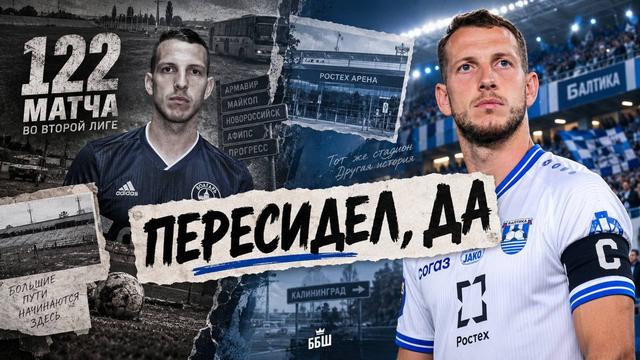
The Baltika midfielder didn't burst into football with a poster billing him as the future saviour. He took the longer road: through the Lokomotiv system, Kazanka, Alania, Neftekhimik, hard adult football with no allowances — and only then reached the role of one of Baltika's most useful players and a debut for the Russian national team.

Russian football loves quick success stories. At 18 you should already be "the new someone", at 19 the highlights, at 20 the talk of Europe. Maksim Petrov is nothing like that.
His story is far less convenient for pretty compilations and loud labels. He didn't fly into the agenda, didn't spend several years with the status of the national team's compulsory future and didn't get advance credit just for coming out of a good academy. With him it was all far more prosaic: the youth team, the second team, loans, the First League, normal adult work. Not a fairy tale — ordinary Russian football. And perhaps that's exactly why there's more truth in this story than in many louder ones.
Many come out of the academy. Not all arrive
Petrov went through the Lokomotiv system, played for Kazanka, then got matches for the first team, but without that "everyone gasped at once" effect. Then came a loan at Alania, a spell at Neftekhimik and only then the move to Baltika in January 2025. Later the club extended his contract to 2030.
That, broadly, is what a normal football biography looks like. Only here, for some reason, normal biographies are often treated almost as failure. If you didn't establish yourself instantly, it's as if you've already fallen short. If you hadn't become "the new Modrić" by twenty, something must have been missing. Whereas in reality adult football often begins exactly where the talk of childhood genius ends.
Petrov, it seems, is one of those for whom early noise would have done more harm than good. Russian football loves to break people with advance praise. Today you're "the future", tomorrow you're to blame for not living up to expectations you never signed up for. Petrov grew up without that unnecessary circus. And perhaps that's why he came out tougher.

Alania and Neftekhimik aren't romance. They're a test of what you're made of
There's a stage of a career where the youthful gloss quickly evaporates from a footballer. For Petrov that stage was Alania and especially Neftekhimik. Nobody there cares how promising you are. What everyone cares about is different: can you sustain the tempo, not drop out of matches, dig in, play regularly and be useful with no allowances for age or surname.
And here Petrov didn't disappear. He didn't dissolve somewhere between "interesting lad" and "where did he actually go?". On the contrary, he gradually assembled himself as an adult player. No special effects, but plenty of substance. Sometimes that's the best route of all: when you're not overpraised ahead of time and you grow without unnecessary froth around you.
At Baltika he stopped searching for himself. And started influencing games
At Baltika it all finally came together. Petrov stopped looking like a footballer still working out his place and became a player who genuinely influences matches.
By the club's official statistics this season he has 20 matches, 1,416 minutes, 5 goals and 4 assists — that's 9 goal contributions. Roughly 0.57 goal contributions per 90 minutes. For a midfielder of his profile that's no longer "nice numbers" but a direct measure of influence.
It's clearest of all in the table.


These numbers matter not in themselves but as a marker: at Baltika his contribution to the attack has become noticeably higher than at previous stages of his career. So this isn't just a good spell, it's the moment when accumulated experience finally turned into real footballing weight.
He isn't about one position. He's about threat
Formally Petrov is a midfielder. In fact he's a hybrid player of the attacking group: he can play as an eight, push up into the ten, appear wider. But the point isn't the labels, it's the function. He isn't about sterile control for control's sake. He's about ball progression, about sharpness, about the episode that starts to smell like a chance.
His strength is working with the ball at speed. Carry it, escape the marker, accelerate the attack, turn the episode to face goal. One match report specifically noted that Petrov, in his trademark style, beat three opponents. And that, perhaps, is a very accurate brushstroke in his portrait.
He's no longer just useful. He's trusted with the decisive moments
There's an important difference between a player who "provides volume" and a player who's trusted with the match. At Baltika Petrov has gradually moved into the second category.
Against Orenburg he scored and was named man of the match. Against Akron — a goal again, and best player again. In the game with Akhmat he produced a goal plus an assist, and later, in the match with Sochi, it was he who was trusted with the penalty.
That's no longer a string of pleasant coincidences. It's a sign of status within the team. When the ball goes to you at an important moment, it usually means you're no longer seen as "a good option" but as one of those who should decide things.
And the coaches say so too
Andrei Talalaev, after the injury story, said Petrov was ready to take the risk but the staff decided to protect him. In another remark after the Akhmat match he spoke specifically about the roughness of the episode in which Petrov got injured and missed the next game. All of this matters not only as a medical detail but as a characterisation of the player's status: that's how you usually talk about a footballer whose absence genuinely affects the team's structure.
Karpin, for his part, made two points that sound even more important. First, Petrov had been watched for a long time. Second, after the national team debut the coach said: "Honestly, I really liked him." So his call-up isn't an accident or an experiment out of nowhere, but the logical continuation of observation.
That's why Petrov's debut for Russia in March 2026 didn't look like a stretch. Rather the opposite: at last, the one who has genuinely grown into it has arrived.

That's the main meaning of his story: you can take the long way and still arrive on time
Petrov's story is good because there's no cheap pathos in it. Nobody was waiting for him as the saviour of a generation. Nobody carried him around for ten years as the future poster boy of Russian football. He simply didn't deflate along the way.
And that, to be honest, is almost a separate talent.
Because in our football people often want to be "the new someone" straight away. The new Cherenkov, the new Golovin, the new anyone. Whereas sometimes it's more useful to first become simply a solid version of yourself. Petrov, it seems, took exactly that path: no hysteria, no compulsory brilliance in his youth, but a normal maturing.
And it's a good lesson for the young
A career doesn't have to take off on the schedule of other people's expectations. You don't have to be a star at 18. You can drop out of the noise. You can go to unglamorous clubs. You can take a long time getting there through leagues where nobody applauds you in advance. And still reach a serious level.
Petrov's story is exactly about that. Didn't work out straight away — no disaster. A loan isn't a sentence. A quiet stage of a career isn't a disappearance. Sometimes the long road is no worse than the short one. Sometimes it's better.
And possibly even more reliable.

Now the main question is no longer whether he has broken through
He has.
The question is different: how high can he stay. Because he has risks too. The injury episode showed an obvious thing: with his style — bursts, dribbling, a large volume of intense work — the load will be very high. So the next stage of his career isn't just about growth in quality, it's a test of durability.
But looking at everything already covered, Petrov has exactly what earlier and louder talents often lack: he didn't ride in on hype, he arrived on substance.
To finish, the traditional plush Baltika man =)